
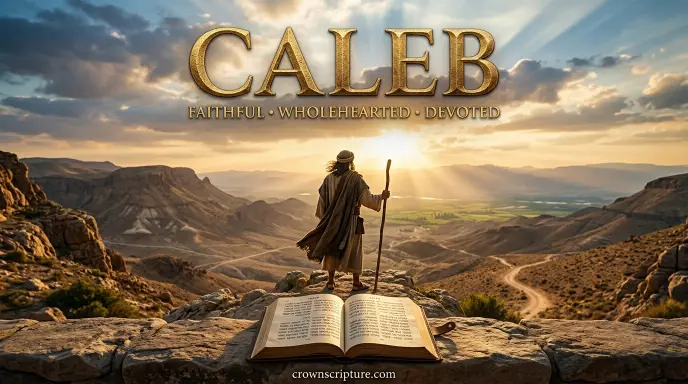
When parents choose a biblical name, they often want more than a beautiful sound. They want a name connected with faith, character, purpose, and God’s Word. One name that carries a powerful biblical story is Caleb.
So, what does the name Caleb mean in the Bible?
The Hebrew name Caleb is commonly connected with kelev, meaning “dog.” Some scholars have also proposed other connections, including ideas related to being wholehearted or devoted. However, Scripture does not directly define Caleb’s name as “faithful” or “wholehearted.” Instead, those qualities become strongly associated with Caleb because of the way he lived.
Caleb was one of the twelve men Moses sent to explore the land of Canaan. Ten spies focused on the strength of the people living there and became afraid. Caleb and Joshua trusted that God would fulfill His promise. Caleb stood before Israel and urged the people to move forward in faith.
His story did not end there.
Decades later, Caleb was still trusting God. At 85 years old, he approached Joshua and asked for the mountain God had promised him. He was not looking for an easy life. He was ready to face the Anakin and fortified cities because he trusted God’s promise. Joshua gave him Hebron as his inheritance.
Caleb’s story therefore gives us a beautiful picture of faith that lasts. His life teaches that trusting God is not only about believing Him in one difficult moment. It is about continuing to follow Him through the years.
What Does the Name Caleb Mean in the Bible?

The name Caleb comes from the Hebrew Kaleb (כָּלֵב). It is commonly associated with kelev, the Hebrew word for “dog.” The exact development of the personal name is debated, so it is wise not to claim more certainty than the evidence allows.
Some Christian explanations connect Caleb’s name with ideas such as:
- faithfulness
- wholehearted devotion
- courage
- loyalty
- determination
These qualities are certainly found in Caleb’s biblical story. But there is an important distinction.
The meaning of the name and the meaning of Caleb’s life are not exactly the same thing.
Scripture repeatedly says that Caleb “wholly followed” the Lord. This description is especially important because it explains why Caleb became such a powerful example of faith.
In other words, the Bible does not need to redefine the Hebrew name Caleb as “faithful” for Caleb himself to become an example of faithfulness.
His life gives the name a rich biblical association.
Why Is Caleb Associated With Faithfulness?

Caleb is remembered for believing God when most of the people around him did not.
When the twelve spies returned from Canaan, ten spies emphasized the size and strength of the inhabitants. Caleb saw the same land but responded differently. He believed God’s promise was greater than Israel’s obstacles.
Numbers 13:30 records Caleb saying:
“Let us go up at once and occupy it, for we are well able to overcome it.”
Caleb was not claiming that Israel’s army was naturally stronger. His confidence was rooted in God’s presence and promise. In the following chapter, Caleb and Joshua reminded Israel that the Lord was with them.
That is why Caleb’s name is often used by Christians as a picture of courageous faith.
Who Was Caleb in the Bible?
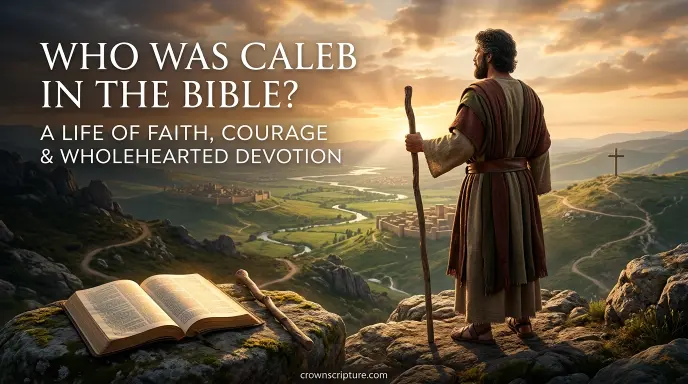
Caleb was the son of Jephunneh and was associated with the tribe of Judah. Numbers 13 lists him among the twelve spies sent by Moses to investigate the land of Canaan.
The twelve men saw the same land.
They saw the same cities.
They saw the same people.
They saw the same obstacles.
But they did not all respond with the same faith.
Ten spies focused on the danger. Caleb and Joshua focused on God’s promise.
Caleb therefore became one of the two adult Israelites from that generation who were allowed to enter the Promised Land after the wilderness judgment. God specifically distinguished Caleb because he had followed Him wholeheartedly.
His story continues in Joshua.
Forty-five years after Moses first sent him to explore Canaan, Caleb was 85 years old. Yet he still remembered God’s promise. He asked Joshua for the hill country of Hebron, where the Anakim lived.
Caleb’s faith had survived decades of waiting.
That may be one of the most encouraging parts of his story.
Faith is not proven only by how we begin. It is also revealed by how we continue.
Best Bible Verses About Caleb
The following passages provide a biblical portrait of Caleb. Together they show his courage, faith, perseverance, obedience, inheritance, and influence.
1. Numbers 13:6 — Caleb Was Chosen as a Spy
“From the tribe of Judah, Caleb the son of Jephunneh.”
Moses selected one representative from each tribe to explore Canaan. Caleb represented Judah.
What This Verse Means
Caleb’s story begins with a specific responsibility. He was not an ordinary observer. He was part of a mission connected with God’s promise to Israel.
His role placed him in a situation where he would have to choose between faith and fear.
Life Application
God may place you in situations where your response matters to other people. Ask Him for wisdom and courage rather than simply following the loudest voice around you.
2. Numbers 13:30 — Caleb Chose Faith Over Fear
“Let us go up at once and occupy it, for we are well able to overcome it.”
This is one of the clearest statements of Caleb’s faith.
What This Verse Means
Caleb did not deny the difficulties in Canaan. He had seen them himself. His difference was that he believed God’s promise was greater than the obstacle.
Life Application
Faith does not mean pretending problems are small. Biblical faith means remembering that God remains greater than the problems we face.
3. Numbers 14:6 — Caleb Grieved Over Israel’s Unbelief
“And Joshua the son of Nun and Caleb the son of Jephunneh … tore their clothes.”
Caleb and Joshua responded with grief when Israel rejected God’s promise.
What This Verse Means
Their reaction shows that faith is not merely positive thinking. They understood that Israel’s unbelief was a serious spiritual matter.
Life Application
A faithful Christian should care about spiritual truth, even when it is unpopular. Loving people sometimes means lovingly pointing them back toward God’s Word.
4. Numbers 14:8 — Caleb Trusted God’s Goodness
“If the LORD delights in us, he will bring us into this land and give it to us.”
Caleb understood the Promised Land as a gift connected with God’s covenant promise.
What This Verse Means
Caleb’s confidence was ultimately about God. He believed that God was able to accomplish what He had promised.
Life Application
When circumstances make God’s promises seem distant, remember God’s character. Trust begins with knowing who God is.
5. Numbers 14:9 — Caleb Rejected Fear
“Do not rebel against the LORD. And do not fear the people of the land.”
Caleb connected fear with Israel’s temptation to turn away from obedience.
What This Verse Means
Fear was not simply an emotional problem for Israel. It was influencing their decision about whether they would trust God.
Life Application
Fear can influence our choices too. Before making a decision based on fear, stop and ask what Scripture says.
6. Numbers 14:24 — Caleb Had a Different Spirit
“But my servant Caleb, because he has a different spirit and has followed me fully…”
This passage gives one of the Bible’s strongest descriptions of Caleb.
What This Verse Means
Caleb stood apart because his response to God was different. He followed God fully while the majority chose unbelief.
Life Application
Following God does not always mean following the majority. Faithfulness sometimes requires standing alone.
7. Numbers 14:30 — Caleb Would Enter the Promised Land
“Except Caleb the son of Jephunneh and Joshua the son of Nun.”
God remembered Caleb and Joshua when judgment came upon the unbelieving generation.
What This Verse Means
Caleb’s faith was not forgotten.
God’s promises were still moving forward even though Israel had to spend years in the wilderness.
Life Application
A delay is not necessarily a denial. God’s timing may involve a longer journey than we expected.
8. Numbers 32:12 — Caleb Wholly Followed the Lord
“For they have wholly followed the LORD.”
This statement summarizes Caleb’s spiritual character.
What This Verse Means
Caleb’s defining quality was not simply bravery. It was wholehearted devotion to God.
Life Application
God calls Christians to more than occasional obedience. He calls us to follow Him with our whole lives.
9. Deuteronomy 1:36 — Caleb Would Receive an Inheritance
“And to him and to his children I will give the land on which he has trodden.”
Moses later reminded Israel that Caleb’s faithfulness would be followed by an inheritance.
What This Verse Means
God had not forgotten His promise to Caleb.
Life Application
When you are waiting for God’s timing, remember that waiting does not mean God has forgotten you.
10. Joshua 14:7 — Caleb Remembered His Calling
“I was forty years old when Moses the servant of the LORD sent me from Kadesh-barnea to spy out the land.”
Caleb remembered an event that had happened 45 years earlier.
What This Verse Means
Caleb had a long memory when it came to God’s promises.
Life Application
Keep a record of God’s faithfulness in your life. Remembering what God has done can strengthen you when another season of waiting comes.
11. Joshua 14:8 — Caleb Followed God Fully
“Yet I wholly followed the LORD my God.”
Caleb personally described his response to the crisis.
What This Verse Means
He did not merely admire faith. He practiced it.
Life Application
Christian maturity is not measured only by what we know. It is also shown in whether our knowledge leads to obedience.
12. Joshua 14:10 — God Preserved Caleb
“The LORD has kept me alive, just as he said, these forty-five years.”
Caleb recognized God’s faithfulness across decades.
What This Verse Means
Caleb did not interpret his survival merely as personal strength. He recognized God’s hand in keeping His promise.
Life Application
Look back occasionally and identify the ways God has carried you through seasons you once thought you could not survive.
13. Joshua 14:11 — Caleb Still Had Courage at 85
“I am still as strong today as I was in the day that Moses sent me.”
At 85, Caleb was still prepared to serve.
What This Verse Means
The passage emphasizes Caleb’s readiness to face the challenge before him.
His confidence was not based simply on age or physical ability. He trusted that the Lord would help him accomplish what God had promised.
Life Application
Never assume that age automatically removes your usefulness in God’s kingdom. Faithful service can continue through every season of life.
14. Joshua 14:12 — Caleb Asked for the Mountain
“So now give me this hill country of which the LORD spoke on that day.”
Caleb did not request the easiest inheritance.
The hill country still contained formidable enemies and fortified cities.
What This Verse Means
Caleb was willing to pursue God’s promise even when doing so involved difficulty.
Life Application
Do not measure God’s calling by how comfortable it is. Sometimes obedience requires courage, patience, work, and perseverance.
15. Joshua 14:13 — Caleb Received Hebron
“Then Joshua blessed him, and he gave Hebron to Caleb the son of Jephunneh for an inheritance.”
Caleb finally received the inheritance promised to him.
What This Verse Means
The promise Caleb had waited decades for became part of Israel’s settled inheritance.
Life Application
God’s timing may be slower than ours, but His faithfulness does not depend on our timetable.
16. Joshua 14:14 — Caleb’s Life Is Summarized
“Because he wholly followed the LORD, the God of Israel.”
This verse gives the clearest summary of Caleb’s legacy.
What This Verse Means
Caleb’s greatest achievement was not conquering territory. It was following God faithfully.
Life Application
When you think about the legacy you want to leave, consider whether people will remember your faithfulness to God more than your accomplishments.
17. Joshua 15:13 — Caleb Received His Portion
“He gave to Caleb the son of Jephunneh a portion among the people of Judah.”
Caleb’s inheritance was connected with Judah.
What This Verse Means
His story became part of the larger story of God’s faithfulness to Israel.
Life Application
Our obedience is never isolated. Faithful decisions can influence families, churches, and future generations.
18. Joshua 15:14 — Caleb Faced the Anakim
“And Caleb drove out from there the three sons of Anak.”
Caleb followed through on his request.
What This Verse Means
His faith was practical. He did not merely talk about trusting God. He acted.
Life Application
Faith and obedience belong together. Ask God not only to increase your belief but also to guide your actions.
19. Joshua 15:16 — Caleb Encouraged Courage
“He who attacks Kiriath-sepher and captures it, I will give him Achsah my daughter as wife.”
Caleb continued leading his family and community toward the work before them.
What This Verse Means
Caleb’s influence extended beyond his own personal story.
Life Application
Faithful people can encourage others to step into responsibilities and opportunities God places before them.
20. 1 Chronicles 4:15 — Caleb’s Family Continued
“The sons of Caleb the son of Jephunneh: Iru, Elah, and Naam.”
The biblical record remembers Caleb’s descendants as well.
What This Verse Means
Caleb’s story was not only about one dramatic moment. His life became part of a continuing family history.
Life Application
The way you live today may influence people you will never meet. Faithfulness can become part of a family’s spiritual legacy.
What Does Caleb’s Story Teach Us About Faith?
Caleb teaches that biblical faith is more than optimism.
He had real reasons to recognize the danger in Canaan. Yet he also had God’s promise.
This gives us an important picture of Christian faith:
Faith sees the obstacle but remembers God.
Caleb did not say the giants were imaginary.
He believed God was greater.
That distinction matters.
Christian faith does not require us to deny difficult circumstances. It calls us to interpret those circumstances in light of God’s character and Word.
Biblical Themes Connected to the Name Caleb
1. Wholehearted Obedience
The strongest biblical description of Caleb is that he wholly followed the Lord.
This phrase appears repeatedly in connection with his story.
Wholehearted obedience does not mean a person never struggles. It means the direction of the person’s life is toward God.
For Christians, this connects with Jesus’ call to love God with the whole heart.
Caleb’s life reminds us that God is worthy of more than divided loyalty.
2. Courage
Caleb demonstrated courage when the majority was afraid.
Biblical courage is not the absence of fear. It is choosing obedience because God is trustworthy.
Caleb’s courage came from confidence in God’s promise.
That makes his story especially relevant when Christians face pressure from friends, culture, coworkers, or even people within their own communities.
3. Perseverance
Caleb waited approximately 45 years between the original promise and receiving his inheritance. Joshua 14 specifically records those decades of waiting.
That makes Caleb an important biblical example of perseverance.
Sometimes God answers quickly.
Sometimes He leads us through a long season of waiting.
Caleb shows us that waiting does not have to destroy faith.
4. God’s Faithfulness
Caleb looked back and said that the Lord had kept him alive just as He had promised.
This is a beautiful example of remembering God’s faithfulness.
When Christians remember what God has already done, they gain strength to trust Him with what remains ahead.
5. Spiritual Legacy
Caleb’s story continued through his family and inheritance.
Scripture even records the names of his sons.
This reminds us that faithfulness can affect future generations.
A parent who prays, serves, forgives, teaches Scripture, and lives with integrity may never see the full impact of those choices.
But God sees them.
Is Caleb’s Name Related to the Word “Dog”?
Yes, the most common lexical explanation connects Caleb with the Hebrew kelev, meaning “dog.” However, the precise origin and intended meaning of the personal name are not completely certain.
This is important because some Christian websites state with certainty that Caleb means “faithful,” “wholehearted,” or “devoted.”
Those descriptions capture Caleb’s biblical character, but they should not be presented as though Scripture explicitly defines the Hebrew name that way.
A more careful explanation is:
Caleb is a Hebrew biblical name commonly connected with “dog,” while Caleb’s biblical character is strongly associated with wholehearted faithfulness to God.
This approach respects both linguistic evidence and Scripture.
Was Caleb an Israelite?
Caleb is identified with Judah in Numbers 13:6, yet other passages call him a Kenizzite.
The exact significance of this background has been discussed by biblical scholars. It may reflect a Kenizzite family incorporated into Israel, and Caleb’s story demonstrates that his place among God’s people was fully recognized.
What Scripture makes especially clear is that Caleb belonged among those who faithfully followed the Lord.
His story therefore also reminds us that biblical identity is deeply connected with belonging to God’s covenant people and trusting God.
Caleb and Joshua: Why Were They Different?
Caleb and Joshua were the only two spies who gave a faithful report concerning Canaan.
The ten other spies emphasized the strength of the inhabitants and caused the people to fear.
Caleb and Joshua emphasized God’s presence and promise.
This does not mean Caleb and Joshua were unaware of the danger.
They saw it too.
The difference was where they placed their confidence.
That is one of the central lessons of the story:
Two people can face the same circumstances and respond differently because they have different views of God.
What Does Caleb’s Story Mean for Christians Today?
Caleb’s story is not a promise that every Christian will receive the exact earthly outcome they desire.
That would go beyond what Scripture teaches.
Instead, Caleb gives us a model of trusting God’s character.
Trust God When the Majority Is Afraid
Popularity is not the measure of truth.
Caleb was willing to disagree with the majority because he believed God’s Word.
Christians should likewise measure beliefs and decisions against Scripture.
Keep Following God During Long Waiting Seasons
Caleb waited decades.
If you are in a season where God’s answer seems slow, his story offers encouragement.
Waiting is not wasted when we continue walking faithfully with God.
Remember God’s Past Faithfulness
Caleb remembered what God had said many years earlier.
Keep remembering God’s faithfulness in your own life.
Prayer journals, Scripture notes, and testimonies can help you remember.
Do Not Let Age Define Your Usefulness
Caleb was 85 when he asked for his mountain.
His story challenges the idea that usefulness in God’s kingdom belongs only to the young.
Different seasons bring different forms of service.
Let Faith Produce Action
Caleb did not stop at a verbal confession of faith.
He acted on what he believed.
Christian faith should influence daily choices, relationships, work, generosity, prayer, and obedience.
Frequently Asked Questions About Caleb’s Name
What does the name Caleb mean in the Bible?
Caleb is a Hebrew biblical name commonly connected with the Hebrew word kelev, meaning “dog.” The Bible does not explicitly define Caleb’s name as “faithful,” but Caleb’s life is strongly associated with wholehearted faithfulness because Scripture repeatedly says he wholly followed the Lord.
Is Caleb a biblical name?
Yes. Caleb is a prominent Old Testament name. The best-known Caleb was the son of Jephunneh, one of the twelve spies Moses sent to explore Canaan. He later received Hebron as an inheritance.
What does Caleb symbolize in the Bible?
Caleb can be understood as a biblical example of faith, courage, perseverance, obedience, and wholehearted devotion to God. These are descriptions of his life rather than a literal dictionary translation of his name.
Why was Caleb different from the other spies?
Caleb and Joshua trusted God’s promise concerning the land of Canaan. The other ten spies focused on the strength of the inhabitants and caused the Israelites to become afraid. Caleb urged Israel to trust the Lord and move forward.
How old was Caleb when he received his inheritance?
Caleb was 85 years old when he approached Joshua about receiving the hill country God had promised him. Joshua 14 records that Caleb had waited 45 years since Moses first sent him to spy out the land.
What land did Caleb receive?
Caleb received Hebron as his inheritance. Joshua 14 says that Joshua blessed him and gave him Hebron. Caleb then drove out the descendants of Anak from the area.
What does “wholly followed the Lord” mean for Caleb?
It means Caleb was distinguished by wholehearted loyalty and obedience to God. Scripture repeatedly uses this description when explaining why Caleb was treated differently from the unbelieving generation.
Is Caleb a good biblical name for a baby?
Caleb is a biblical name with a strong biblical association because Caleb’s story emphasizes faith, courage, perseverance, and devotion to God. Parents choosing the name should distinguish the historical meaning of the Hebrew name from the spiritual qualities demonstrated by the biblical Caleb.
A Short Prayer Inspired by Caleb
Lord God,
Give me the faith of Caleb to trust You when circumstances look difficult.
Help me remember Your promises without pretending that challenges do not exist.
Give me courage to obey Your Word when others choose a different path.
Teach me to follow You wholeheartedly, patiently, and faithfully.
When I must wait, help me trust Your timing.
When I am afraid, remind me of Your presence.
And when I reach a new season of life, help me continue serving You with joy.
May my life point others toward Your faithfulness.
In Jesus’ name, amen.
Conclusion:
The deepest lesson of Caleb’s life is not simply the meaning of his name.
It is the meaning of a life lived in faith.
Caleb saw what others saw, but he trusted God differently.
He faced opposition.
He endured decades of waiting.
He grew older.
Yet he never abandoned the promise he had received.
At 85, he was still ready to move forward.
That makes Caleb’s story especially encouraging for anyone who feels that the waiting has been too long or the obstacles are too large.
God’s faithfulness is not limited by our circumstances.
So whether you are beginning your walk with Christ, raising a family, serving in ministry, facing a difficult decision, or simply waiting for God’s direction, Caleb’s example gives you something worth remembering:
Keep following the Lord wholeheartedly.
Your circumstances may change.
Your season may change.
Your strength may change.
But God remains faithful.
As Scripture teaches:
“Do not be anxious about anything, but in everything by prayer and supplication with thanksgiving let your requests be made known to God.”
And the peace of God guards those who trust Him.
Caleb’s life reminds us that faith is not merely believing God for one moment. It is continuing to walk with Him for the long journey.
That is a legacy worth pursuing.

I am Naqash Ayub, the writer behind CrownScripture, where I create clear, thoughtful, and Bible-centered content to encourage spiritual growth. My goal is to make Scripture easy to understand through trustworthy, meaningful, and reader-friendly articles that inspire faith and daily living.